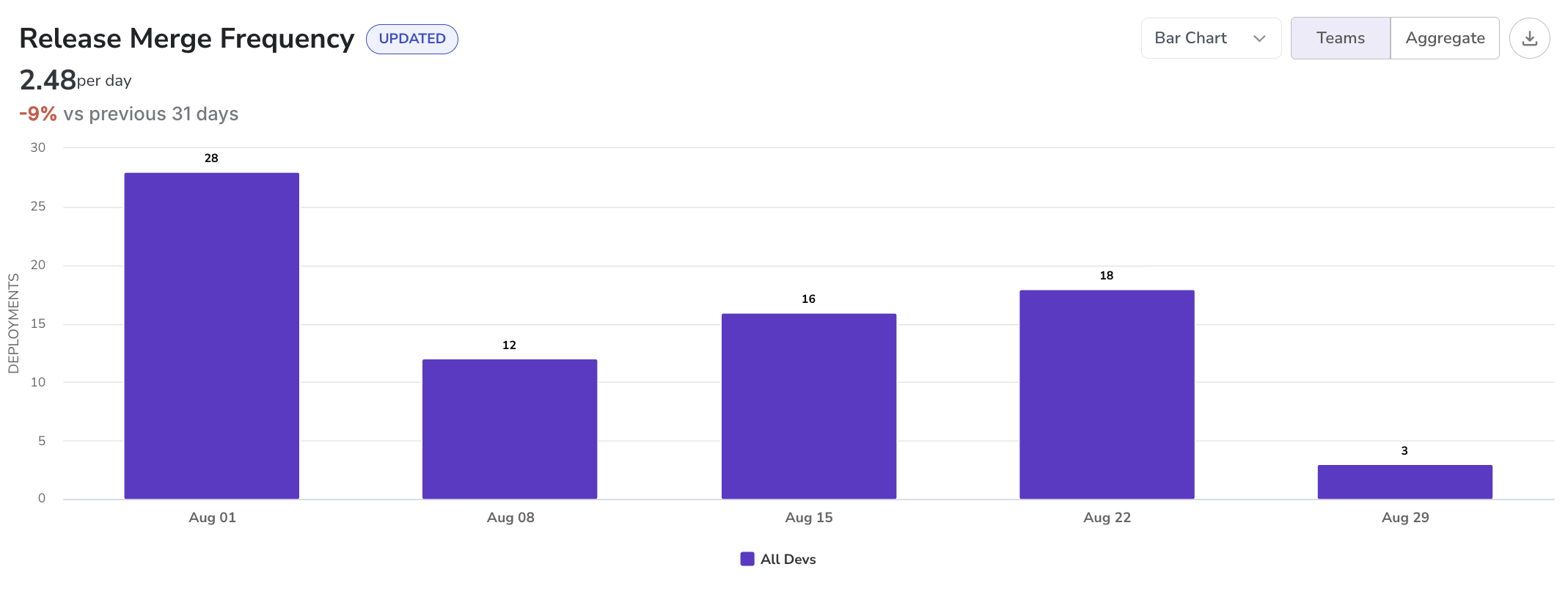
> For the complete documentation index, see [llms.txt](https://docs.hivel.ai/llms.txt). Markdown versions of documentation pages are available by appending `.md` to page URLs; this page is available as [Markdown](https://docs.hivel.ai/using-hivel/cockpit/metrics-and-definitions/speed/release-merge-frequency.md).
# Release Merge Frequency
### **Release Merge Frequency**
#### Formula =
```
(Total number of PRs merged to master or main in that selected time period) /
(Total number of days in the time period)
```
* Release Merge frequency measures how often code is merged to the main/master branch. Elite Release Merge Frequency represents a stable and healthy delivery.
* This metric would help you understand the number of PRs being pushed to production in a given time. This can work independently of your sprint cycle time. You can learn more about them [here](https://cloud.google.com/blog/products/devops-sre/using-the-four-keys-to-measure-your-devops-performance).
* Too low Release Merge frequency indicates that there may be bottlenecks in review, or requirements, and teams are delivering features at a slower pace.
* High Release Merge frequency shows that your team can quickly provide value and react to feedback or changes.
#### Industry Benchmarking